Your Credit Card Points Are Probably Worth Way More Than You Think
By Sunny S Pujari ·
You have a travel card. You earn points. You maybe redeem them through the portal for a mediocre flight. You move on with your life. Sound about right?
I get it. Every time someone brings up "travel hacking," your eyes glaze over a little. It sounds like something that requires a spreadsheet, a PhD in airline alliances, and way too much free time. You've got a Chase Sapphire or an Amex Gold because someone told you it was "the card to get," and yeah, you use the points sometimes, but the whole obsession with maximizing redemptions? That feels like a hobby for people with very different priorities.
I used to think the same thing. Then I accidentally stumbled into the math — and the math changed everything.
My name is Sunny, and over the last few years I've flown to Paris, Tokyo, Brazil for Carnival, Iceland, Portugal, Turks and Caicos, and all over the US. The total I've spent on flights and hotels across all those trips combined? Less than $10,000.
Not per trip. Total. For all of them.
I'm not a millionaire. I didn't exploit some secret loophole that got shut down. I just learned how to use the points I was already earning in a smarter way. And once you see how it works, you can't unsee it.
This post is going to take you from "I don't get the hype" to "oh... oh." Give me ten minutes.
The Problem With How Most People Use Points
Here's what typically happens. You have, say, 60,000 Chase Ultimate Rewards points. You go to the Chase travel portal, search for a flight, and it tells you the flight costs 48,000 points. You book it. Done.
And look, that's fine. You got a flight. But here's the thing nobody tells you upfront: the portal values your points at a fixed, mediocre rate. If you have a Chase Sapphire Preferred, your points are now worth just 1 cent each in the travel portal — Chase actually removed the old 25% bonus in 2025. Even the Sapphire Reserve only gets a boosted rate on select rotating offers through something called Points Boost, and those offers change constantly. For most bookings, you're getting somewhere between 1 and 1.5 cents per point through the portal — no matter whether it's a $200 domestic hop or a $5,000 business class seat.
The same story plays out across cards. Amex, Capital One, Citi — their travel portals all give you a fixed, floor-level value for your points. It's easy, sure. But easy and optimal are very different things.
What if those same 60,000 points could be worth 2, 3, or even 8 cents each?
That's not a hypothetical. That's what transfer partners do. And the best way to explain it is to show you.
A $500 Flight for $284
Say you want to escape the winter cold and fly from Boston to Turks and Caicos. You pull up Google Flights and find round-trip economy tickets from Boston (BOS) to Providenciales (PLS) on American Airlines for around $500 per person. Not crazy expensive, but not nothing — especially if you're booking for two.
Now here's what happened when I searched for the same flight using miles.
American Airlines sometimes releases seats at steeply discounted award prices — the industry calls this "saver" availability. Think of it like a flash sale, but for points. When saver space is open, the miles price drops dramatically compared to what you'd normally see. And for economy flights, saver availability is surprisingly common, especially if you're booking a couple months out or flying midweek.
For this Turks trip, saver space was wide open. That same $500 round trip? 16,000 AAdvantage miles + $124 in taxes. If you value those 16,000 miles at the portal floor rate of 1 cent each, that's $160 in points + $124 in taxes and fees = $284 total. A savings of about $216 and a value of 2.35 cents per point — more than double what any credit card portal would give you for those same points.
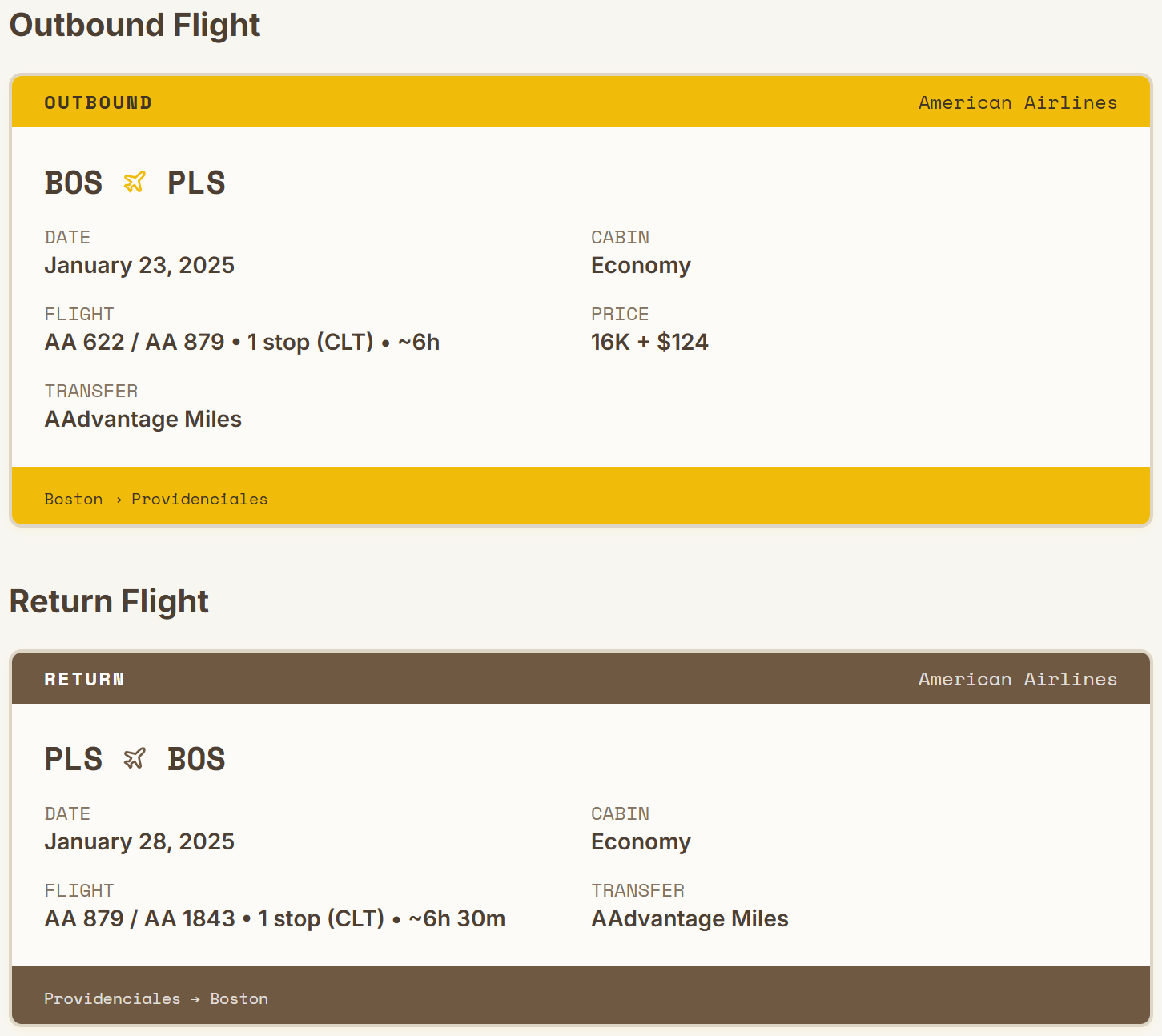
Nice, right? Save a couple hundred bucks on a beach trip. But I know what you're thinking — that's a solid deal, not a life-changing one.
So let me show you where this gets absurd.
A $7,583 Seat for $42
A business class ticket from Dallas (DFW) to Auckland, New Zealand on American Airlines costs roughly $7,583 in cash. That's the kind of number that makes you close the browser tab and accept you'll never fly at the front of the plane.
Here's what I actually booked:
89,500 AAdvantage miles + $42.30 in taxes.
That's it. A nonstop, lie-flat business class seat on AA Flight 35 — 15 hours and 40 minutes straight to Auckland with dinner, breakfast, and champagne. I got those 89,500 miles by transferring Citi ThankYou Points at a 1:1 ratio. So 89,500 Citi points became 89,500 AA miles, and I booked a $7,583 seat for forty-two dollars.
That's 8.43 cents per point — more than 4x the minimum target value for Citi ThankYou points.
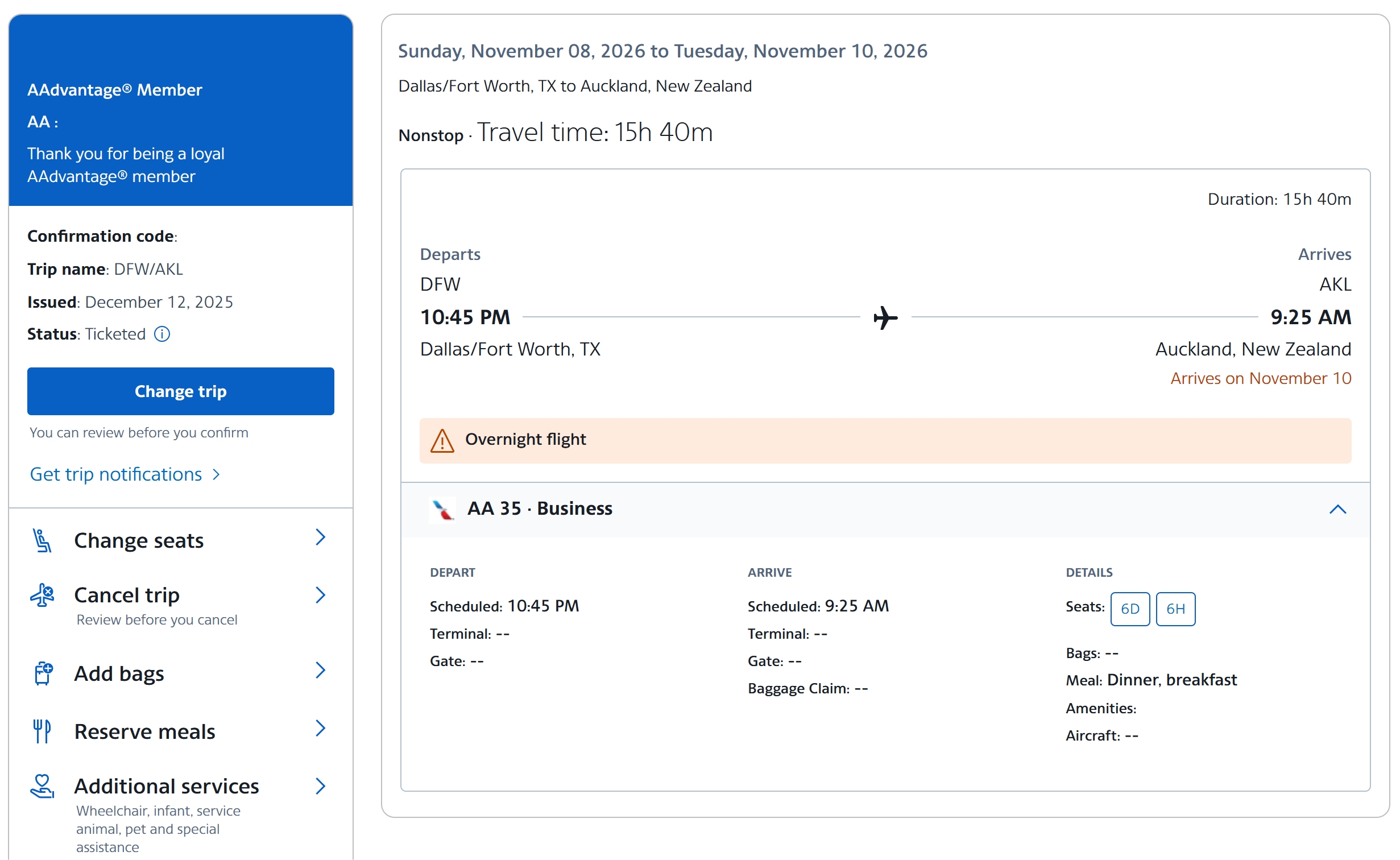
For the return, I booked economy on Delta from Auckland to Boston for 38,000 SkyMiles + ~$62 — the "fly premium one way, save on the way back" strategy. Let's be real, most of us don't earn enough points to fly business class in both directions every time (earning strategies are a whole separate post that's coming). But the one-way premium booking is the sweet spot: you get the lie-flat experience outbound without needing a massive points balance.
So what did this whole trip actually cost? Let me show the math. My actual cash out of pocket was just $42.30 in taxes on the outbound + ~$62 in taxes on the return = about $104 in real money leaving my bank account. The rest was covered by points.
Now, if you value those points at the portal floor rate of 1 cent each — the minimum they're worth — the outbound cost me 89,500 points ($895 in value) + $42.30 in taxes = $937 for a business class ticket that retails for $7,583. The return adds 38,000 points ($380) + ~$62 in taxes on top of that. But the headline number is what matters: that outbound business class seat cost $937 instead of $7,583.
Total savings: roughly $6,645.
Same seat. Same plane. Same lie-flat bed. I just used a different door to get in.
At this point you're probably in one of two places. Either you're thinking "that's insane, how do I do this?" — or you're thinking "OK, what's the catch? I never see deals like this when I'm booking."
The honest answer is: both questions have the same answer.
How This Actually Works (And What It Takes)
The concept behind both of those deals is the same: instead of redeeming points through a credit card portal at a flat rate, you transfer your credit card points to an airline loyalty program and book directly through that program's award system.
Your credit card points — whether they're from Chase, Amex, Citi, Capital One, or Bilt — can be transferred to airline and hotel loyalty programs, usually at a 1:1 ratio. But different airline programs charge different amounts of miles for the same seat on the same flight. One program might want 120,000 miles for a business class seat to Auckland. Another partner in the same alliance might charge 89,500 for that exact same seat on the exact same plane.
That price difference is the whole game.
The tricky part is knowing which partners to check — and that's where the first tool comes in.
Finding Your Transfer Partners
The Transfer Partner Lookup does the homework for you. You select the airline you want to fly and the credit card points you have, and it shows you every loyalty program you can transfer to that can book that airline — including their alliance membership and transfer ratios.
For the New Zealand trip, I selected American Airlines and Citi. The tool showed me that AA is part of the Oneworld alliance, and my Citi ThankYou points could transfer 1:1 to AAdvantage directly, or to other Oneworld partners like Qantas, Etihad Guest, and Qatar Airways.
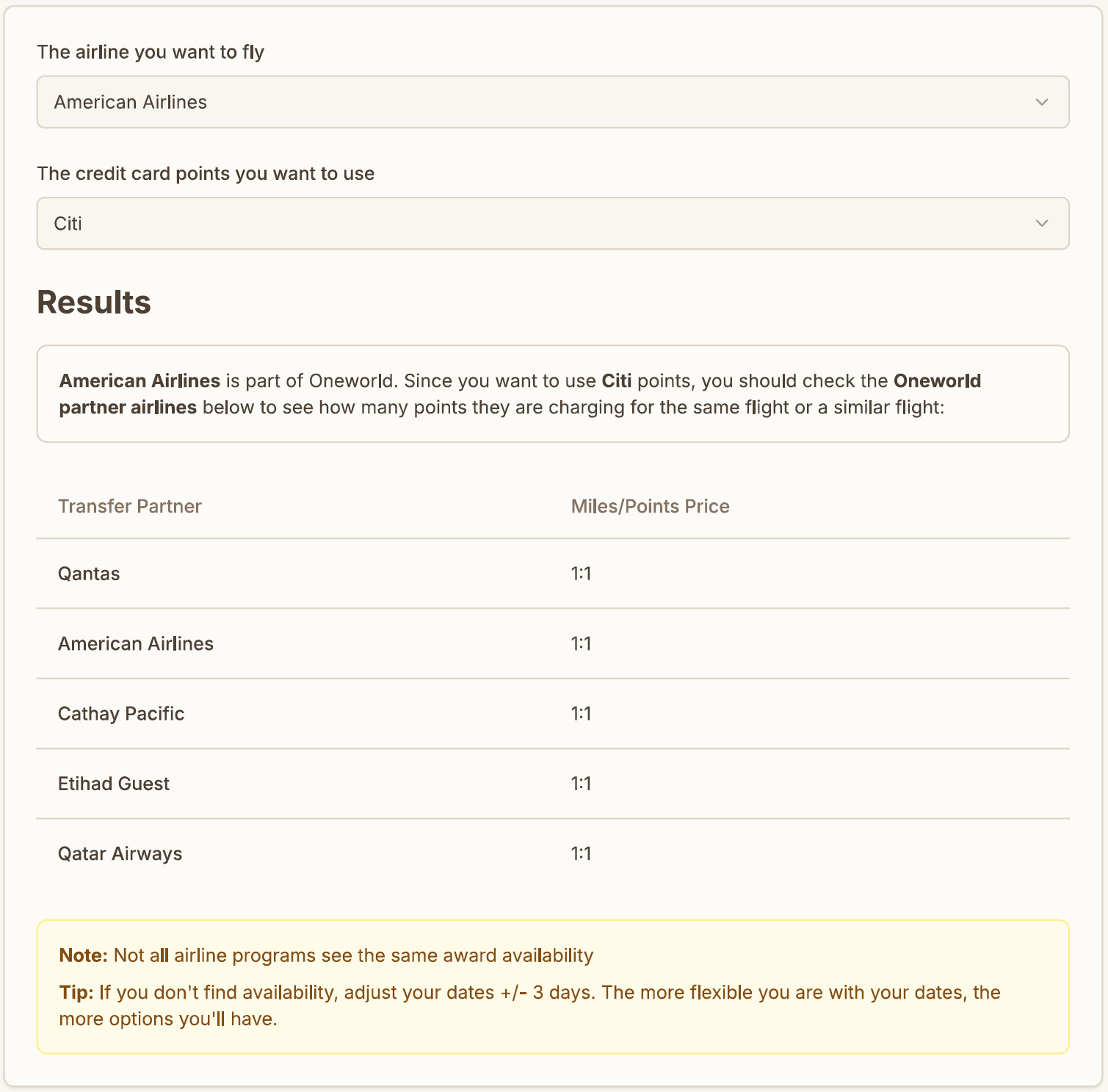
Here's the important nuance: not all of those partners will show you the same availability or charge the same price. American Airlines might display business class saver space on aa.com, but when you search that identical flight through Qatar Airways, it might not appear at all — while Etihad Guest might show it at a different price. That's why the tool is so valuable. It gives you a list of doors to try, and you check each one until you find the best deal.
The whole process takes about 30 seconds in the tool, then another 15-20 minutes searching the partner websites for saver award space.
Knowing If the Deal Is Worth It
Once you've found availability, the next question is whether this is actually a smart use of your points or if you'd be better off paying cash and saving them for something even better.
The Points or Cash Calculator makes this a no-brainer. You plug in the cash price of the ticket, the taxes and fees when booking with points, the number of points required, and which credit card program you're transferring from. Hit calculate.
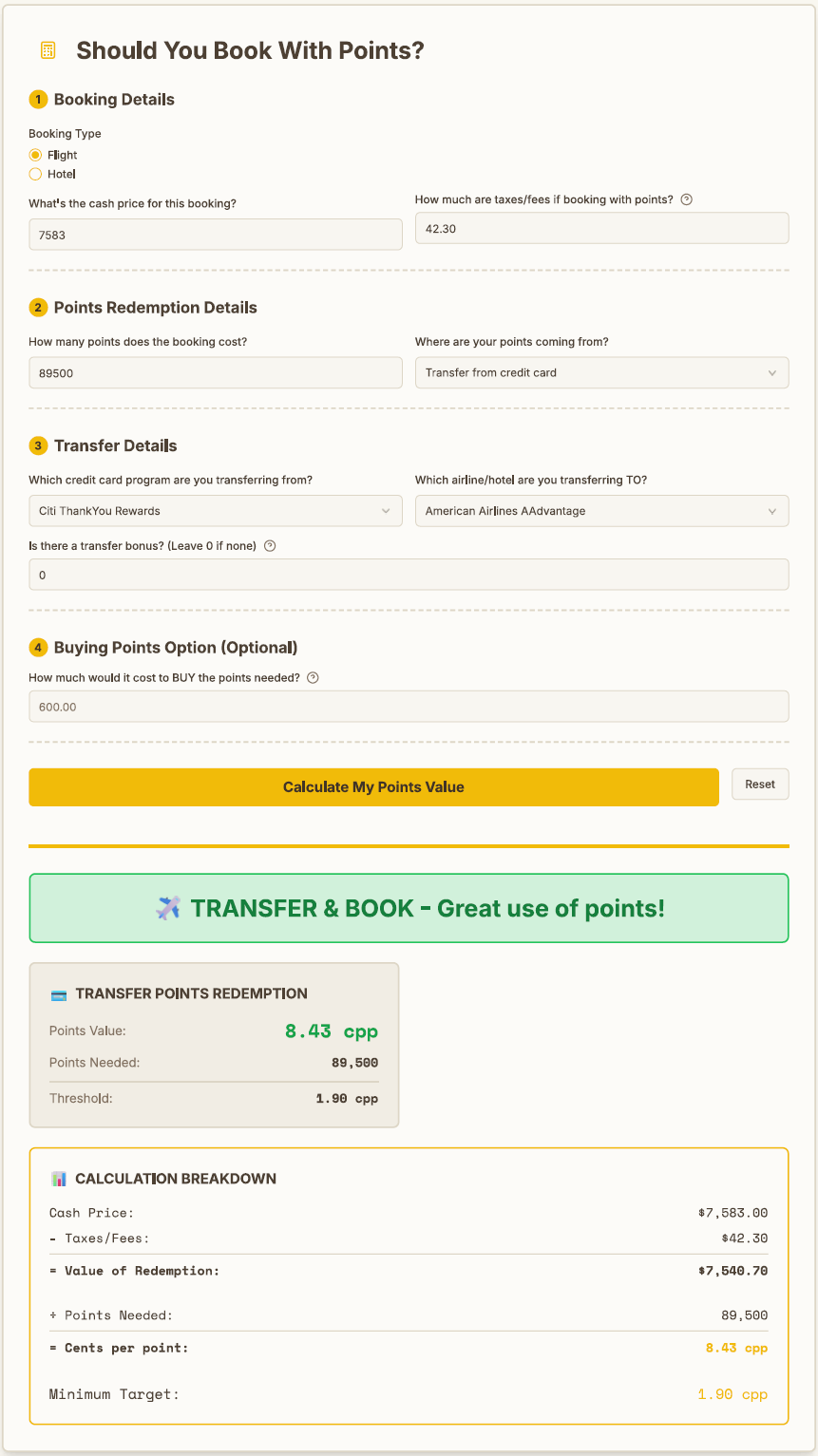
For the Auckland trip, the calculator returned a clear green banner: "TRANSFER & BOOK — Great use of points!" The breakdown showed 8.43 cents per point against a minimum target of 1.90 cents. Not even close — this was an obvious win.
If the calculator had shown something below the threshold — say 0.9 cents per point — the answer would be the opposite: pay cash, keep your points, and wait for a better opportunity.
Two Things That Can Supercharge (or Sabotage) a Deal
Transfer bonuses are the supercharger. Credit card companies periodically offer boosted transfer ratios to specific airlines — something like "get 30% bonus miles when you transfer to AAdvantage this month." If that promotion happens to be running when you find your deal, those 89,500 miles might only cost you around 69,000 points from your credit card balance. Same seat, fewer points. Your cents-per-point value jumps even higher.
Speculative transfers are the sabotage. Here's the cardinal rule: never transfer points to an airline program until you've confirmed the award space is available and you're ready to book. Transfers are one-way and irreversible — once your Citi points become AAdvantage miles, they're not coming back. The workflow is always: find availability first, then transfer, then book. Not the other way around.
The Hunt
I've shown you two deals and the tools that make them possible. Now let me be straight with you about what it actually takes to find deals like these, because I don't want to oversell it.
Economy deals are the easy win. Saver award space in economy is genuinely common. If you have some flexibility on travel dates and you're searching a couple months out, you'll find good redemptions regularly. Even last-minute, economy award prices can bail you out — imagine needing a next-day flight from New York to LA that costs $2,000 in cash, but the saver award price is still sitting at 7,500 miles one-way. That's the kind of moment where points go from "nice to have" to "thank god I had those."
Business class is where the real hunting begins. Premium cabin saver space is scarcer, and how hard it is to find depends a lot on the route. A business class seat from Boston to St. Louis? That's a low-demand route — saver space is likely available across a wide range of dates, peak season or not. But Dallas to Auckland or Boston to Tokyo? Those are highly desirable international routes, and airlines know it. Saver space on those flights is competitive.
For those popular routes, your best windows tend to be either very far out — 6 to 12 months in advance, when airlines first load their award calendar — or within the last week before departure, when unsold premium seats sometimes open up. In between, saver availability is spottier (though not impossible — it depends on the route, the season, and plain luck).
One trick that can open up more options: repositioning. If there's no business class saver space from your home airport, there might be availability from a nearby hub. A cheap domestic flight or a short economy award hop to a different departure city can unlock international business class inventory that didn't exist from your origin. It adds a small cost and a connection, but when it means the difference between paying $7,583 and paying $42 — it's worth considering.
Does finding these deals require some flexibility and searching? Yes. But it's not as burdensome as it sounds — especially once you know where to look. You don't need to spend hours a day monitoring flights. You just need to be willing to check a few dates, try a few partner websites, and be ready to book when the deal shows up. The people who consistently book $7,000 seats for under $1,000 aren't lucky — they're persistent, flexible, and they've built a simple habit of checking.
What to Do With All This
If I could distill this entire post into a mindset, it's this: your points are a currency, not a coupon — and they're a currency that loses value if you sit on it.
Airlines and hotel programs devalue their award charts regularly, sometimes without warning. The business class seat that costs 89,500 miles today could cost 120,000 miles next year after a quiet program "update." Those 100,000 points you've been hoarding? They can lose half their purchasing power overnight. So when you have enough points and you've found a good deal — book it. Don't wait for perfection. Earn and burn.
And the good news is that earning enough points for trips like these is not as hard as it sounds. You don't need a wallet stuffed with credit cards or to overhaul your spending habits. One to three cards optimized for how you already spend is genuinely all it takes to build up meaningful balances. That's a topic for a future post — for now, just know that the earning side is way more accessible than the points world makes it seem.
Here's what to do next:
Bookmark SunnysPoints.com. Before your next trip — any trip — run through this process:
Use the Transfer Partner Lookup to see which partners can book your airline
Search those partners for saver award space
Run the best option through the Points or Cash Calculator
If the math works, transfer and book. If not, pay cash and keep your points ready for the next one.
The tools are free. They'll be here every time you need them.
The points sitting on your card right now might be worth a lie-flat seat to Auckland, a week on the beach in Turks and Caicos, or Carnival in Rio. But you won't find those deals booking through a credit card portal. You'll find them by hunting — and now you know where to start.
Have a specific trip you're trying to figure out? I'm always happy to help — that's literally why I built this. Drop me a note and let's find the best way to use your points.